The return of England’s wildcats!

Three families of wildcats are starting to be reintroduced in England this year after the species was declared extinct more than 150 years ago. Conservationist Derek Gow, who is an expert on mammal reintroductions, is building England’s first wildcat breeding complex on his farm in west Devon. He hopes to introduce the cats into the complex this year and then release them into the wild in three years’ time. His aim is to have a population large enough to breed 150 wildcat kittens every year.

These fierce felines were once widespread throughout English woodlands but after centuries of persecution they were declared extinct in the 1860s. The last confirmed sighting was in 1849. The Scottish wildcat, also known as the Highland tiger, is the only native member of the cat family still found in the wild in Britain. There are just a few dozen left.

Mr Gow wants to bring wildcats back to the areas where they previously thrived. “We’re hopefully releasing three litters of kittens into the complex this year, and then eight next year,” he told The Independent. “We’re aiming to get to the stage where we have a cat breeding population capable of producing 150 kittens a year. This should happen in three years and then we’ll start releasing them into the wild. I would like to have wild cats all over the UK,” he said.

Mr Gow posted pictures of his enclosures on Twitter. “Trepidation aside it’s going to look wonderful. We have decided to set one caravan next to the cat breeding pens so that the kittens playing in the evening can be viewed,” he said. Wildcats have been living in Britain since at least the last Ice Age. They were rumoured by some to be man-eating predators and revered by others as quasi-mythical. In practice these cats are incredibly shy and avoid all human contact but centuries of hunting took their toll.

“Wildcats were hunted ruthlessly in the past because they were a very effective predator,” said Mr Gow. “In the middle ages, rabbits provided people with meat all year around and were a ready available source of fur. Wildcats were hunters of rabbits so people worked hard to kill them. Then after the industrial revolution the gamekeepers finished them off,” he said.

English financier and environmentalist Ben Goldsmith who is helping to fund the project said: “We have a moral duty to put right the wrongs that we’ve perpetrated in the past.” “Wildcats are a keystone species and an important predator in the system. If you lose predators from an ecosystem you create imbalance and ecosystems don’t function correctly,” said Mr Goldsmith, who is also an adviser to Michael Gove and the Department for Environment, Food and Rural Affairs (Defra).

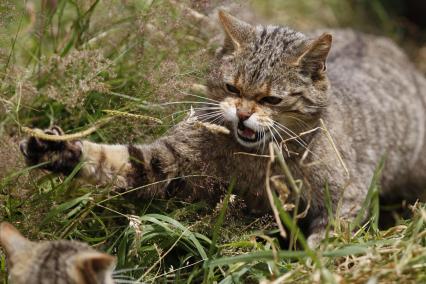
The typical British wildcat is similar in appearance to a domestic cat but they are larger with a wider face and jaw. They have well-defined brown and black stripes and a bushy tail. The species is listed as critically endangered in Scotland. At the end of last year a major study found that the Scottish population had interbred with domestic cats so much that they shared the same gene pool and were therefore “functionally extinct” in the wild.

There are about 100 wildcats in captivity in the UK with stronger wildcat genes. “Most of the wild cats are complex hybrids of domestic cats and the only way we’re going to save these cats from extinction is to start breeding them,” said Mr Gow, who got his cats from a zoo in February. They are already in enclosures but without access to their natural environment.

“The best habitats are in southern England. At the end of the day, wildcats are meant to be here,” he said. “Hybridisation doesn’t occur when you have a healthy population of wild cats,” according to Mr Goldsmith. He said Scottish wildcats hybridised with domestic cats because the population was so weak. “We should see fewer feral domestic cats in the countryside because these pure wildcats will win the competition,” he said.  Mr Gow expects the cats to have a significant impact on reducing the number of grey squirrels, which are a non-native species. A Defra spokesperson said: “The movement and release of any species in England, including wildcat, should follow the International Union for Conservation of Nature guidelines. “These guidelines ensure there are clear environmental and socioeconomic benefits to gain from releasing the animals and that their welfare is maintained.”

A National Farmers’ Union spokesperson said the potential effects of reintroducing a species needs to be fully understood before these animals are released. “Any species introduction, particularly if it has been absent from this country for many decades or even centuries, can have massive impacts on the many benefits that the countryside and farming delivers. The landscape could be very different and this poses potential risks,” the spokesperson said.
wildcats-3

Throwing wildcats to the wolves!

The zoologist George Monbiot is an advocate of ‘rewilding’ the UK particularly in Scotland. He and fellow eco-warriers claim that the lynx and the wolf should be brought home to the UK as lost British native species. Hard evidence of lynx’ presence in the UK is almost non existent however. The introduction of lynx to Scotland would almost certainly spell the end for the already threatened Scottish wildcat (separate blog to follow) as the two species do not co-exist as proved in mainland Europe. The wolf was indeed native to the British Isles but at a time when it was far more biodiverse, more extensively wooded and more thinly populated than today.  Geological estimates vary, but it is thought the wolf’s demise in the UK was was around 1760.

Needless to say, farmers, walkers and other groups are opposed on safety grounds. Furthermore, the argument that rewilding would boost tourism is somewhat misplaced as both animals are shy and retiring. Surely better to concentrate on the current threatened wildlife such as the harvest mouse, hazel dormouse or the Dartford warbler; perhaps they don’t engender the same romance!

In deepest Devon at the Wildwood Escot Estate live a pack of six wolves; four intact males and two neutered females. They live in perfect harmony without any animosity, aggression or an apparent alpha. They recently arrived from a zoo in Denmark via Sweden and are the subject of collaborative observation.

In the 1950s/60s, L David Mech Phd, conducted studies on a pack of captive wolves in Ellesmere Island, in modern day Nunavut (previously part of the Northwest Territories), Canada. This concentrated primarily on observing the interactions of pack members with each other and with pups around a den. He observed a hierarchy relying on domination and the aggression of an alpha, usually a male. The conclusion was that ALL wolves, and indeed dogs, acted this way. What he failed to allow for was that the pack consisted of unrelated animals living in a false environment. This has resulted in a myth that persists today with some dog trainers emulating this ‘pack theory’, using dominance to obtain results.

So how do the Escot wolves live in peace? One theory is that they do not have to compete for resources or females and all are still young. In time, of course, this may change, so we watch with a great deal of interest and anticipation! (See also separate blog here).

No discussion about wolves would be complete without a mention of Wolf Watch UK. This was established at a centre in Shropshire in 1993 by the founder Tony Haighway. His initial involvement with wolf conservation started with the rescue of a pair of wolves from a closing zoo in Warwickshire. From these small beginnings, Wolf Watch UK has gone on to provide sanctuary for over thirty displaced wolves to date. “They normally arrive in the centre as a consequence of dominance fights, zoo closures or excess breeding. Without our help many of these magnificent animals would have probably been euthanised” Tony states in a recent interview.

The Wolf Watch Centre is located in approximately one hundred acres of remote wooded valley in Shropshire and is staffed by a team of dedicated volunteers. Wolf Watch UK is a private membership wolf conservation group. Access to the project is strictly via the Adopt-a-Wolf membership scheme or approved wolf conservation groups or similar, with permission to bring visiting parties during pre-arranged days.

Tony goes on to say: “We are somewhat unique in our ethos, as it is based entirely around the welfare of the animals in our care and to provide them with sanctuary, we refuse to exploit them for monetary gain. We do not operate along the conventional lines of being a public paying zoo style attraction, but rely solely on membership subscriptions, donations and fund raising from open days, our adopt-a-wolf scheme, photography days, guided tours and associated events”.

The ‘Shropshire Star’ recently reported that the go ahead has been given for the expansion of the centre to include holiday lets and an educational facility. Design consultants have been employed to ensure the building work is in sympathy with the environment. The plans were universally supported by locals and groups including Shropshire Wildlife Trust, Herefordshire and Ludlow College and the local parish council.

Virginia McKenna OBE, founder trustee of The Born Free Foundation, has visited the sanctuary on a number of occasions and in a letter to Shropshire Council the actress said: “I have always left uplifted and encouraged to see such genuine understanding of the individual characters and needs of the wolves. It is, I believe, an ideal environment to bring people who wish to understand more about these animals”.

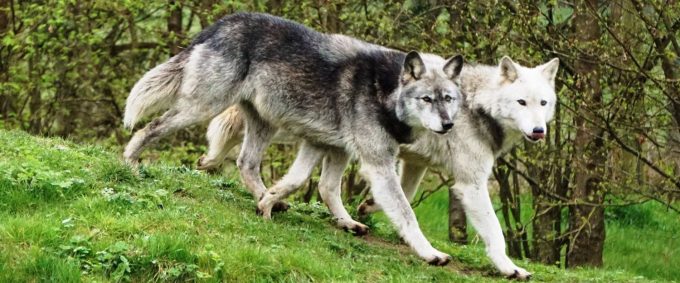
Picture shows a pair of wolves at the Wolf Conservation Trust, Beenham, near Reading. Visitors can enjoy guided tours, walks, night howling sessions and photographic days.

cropped-25073282_10214596357040118_3417151793725120847_o.jpg

Photograph by Richard Jarrold