ORIGINS
When talking about Samba and its Brazilian origins, it would be remiss not to mention the importance of the Atlantic Slave Trade and, in particular, the slave trade between West Central Africa and Brazil. In the early Portuguese colonial era Brazil imported more enslaved Africans than any other country in the world. Out of the 12 million Africans who were forcibly taken to the New World, approximately 5.5 million, some 45%, were taken to Brazil alone in the period 1540 to the 1860s. The Portuguese reputedly entered the interior of Africa as demand for slaves in Brazil grew. Along with those transported to North Central America and the Caribbean came many musical influences heard today in blues, gospel, jazz and Latin American. Though slaves may have been denied the right to practise their religious beliefs, they were often allowed to sing as they worked in the sugar, tobacco, cotton and coffee plantations. Through these worksongs and dancing they were able to communicate with each other over long distances, facilitating the sense of community that still exists; thus laying the foundations of today’s Afro-American music.
RECENT HISTORY
Often associated, by foreigners, with soccer and the world’s largest rainforest, Brazil, and in particular Rio de Janeiro and the northeastern state of Bahia, is synonymous with the musical genre samba, connecting the past with the present. Present in the Portuguese language at least since the 19th century, the word ‘samba’ was used to designate ‘popular dance’ and is a prefix to several rhythmic variants such as ‘samba de Roda’ – rural samba, ‘samba carioca’ and others. The word ‘samba’ is itself derived from ‘semba’ a Bantu word for dance or navel bump. Furthermore, its origins express political and cultural resistance from historically marginalized and excluded peoples making it a cultural, social and historical phenomenon of great importance. Given this, it comes as no surprise that the history of samba arouses significant interest amongst scholars, educators and enthusiasts of the genre. Indeed, Brazilian law mandates for the teaching of Afro-Brazilian history and culture in elementary and high schools.
The strong Afro-Brazilian cultural presence in the city centre of Rio de Janeiro and the port area spread throughout the entire city as a result of early 20th century reforms. These included an ambitious modernization project aimed at giving the capital a resemblance to European cities, especially Paris. The reform project included the demolition of a large number of tenements and low-income housing in the city centre, justified, at the time, by their precarious and unsanitary conditions. Known as the ‘bota-abaixo’ (‘knock it down’) policy, it displaced large numbers of slave descendants from the region to the surrounding hills and train stops, forming favelas and suburbs. Samba became more organized with ‘schools’ starting to appear bringing together people of different backgrounds and social classes. Carnivals and parades are now an important part of Brazilian culture attracting many millions of visitors each year from around the globe.
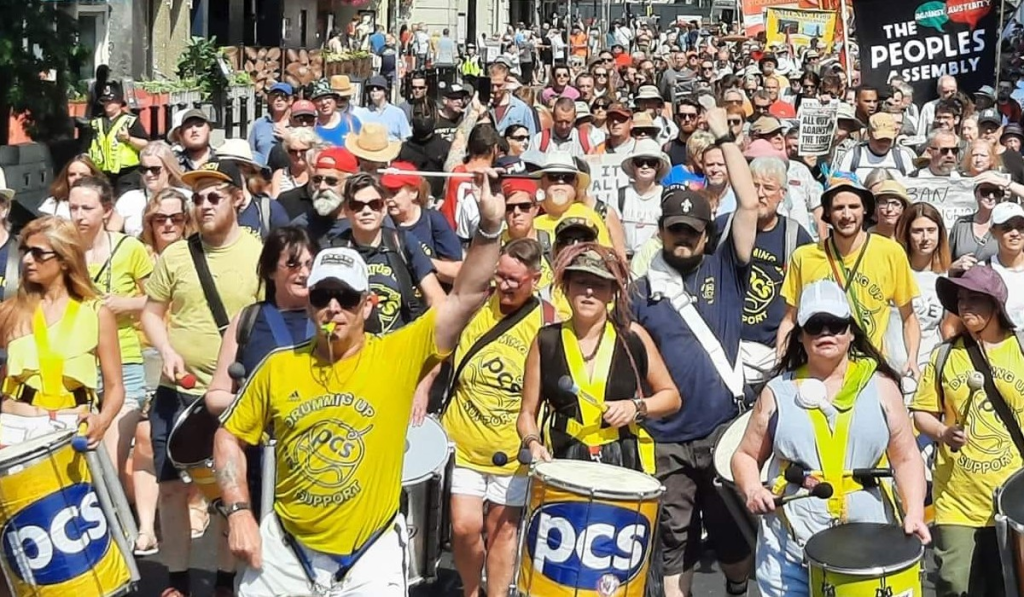
A modern day community Samba band gathering
TODAY’S SAMBA
Of course, modern day samba bears many European and Latino influences. The Brazilian couples dance maxixe with its lundu and polka influences, sometimes known as the Brazilian Tango, is a high energy, uplifting dance with a 2/4 syncopated time signature. The music depends on interlocking patterns or a polyrhythm, relying on the musicians and dancers developing a natural sense of rhythm and coordination rather than the more western tradition of ‘counting’. Other common time signatures in samba are 4/4, 3/4 and even 13/16. We know that rhythmic patterns, especially those involving deep bass drums (surdos) as found in samba, play a game with the pleasure system of the brain, feeding our neural pathways with a dopamine reward. Little wonder, therefore, that this music invokes a primal, emotional response, perhaps reminiscent of one’s ancestral heartbeat! However, carnival samba differs significantly to the more formal ballroom samba and the Brazilian partner dance Samba de Gafieira.
The more relaxed Bossa Nova style, derived from samba, places more emphasis on melody rather than percussion and made Brazilian music a worldwide phenomenon. Samba is much distinguished by its ‘swing’, a specific way of interpreting rhythms where eight notes are played like triplets creating a galloping sound. However, there is a danger we become overly theoretical here which is beyond the realms of this blog. Let’s not forget that the original ‘semba’ would have passed down the generations by word of mouth until someone, persons unknown (!), attempted to write it down! Over time, these rhythms began to spill into different genres – most notably jazz and the big band sounds of the ’20s and ’30s, but also rock, traditional music and others.
I have spoken about syncopation and polyrhythms. These are not the same thing though a single rhythm OR polyrhythm can have syncopation. SYNCOPATION refers to the off-beats or in-between beats of a rhythm as found, for example, in flamenco. POLYRHYTHMS, whilst playing tricks on the ear, strictly speaking refers to two or more ostinato rhythms of differing time signatures, playing simultaneously and at the same tempo, adding character and danceability! OSTINATO refers to a short rhythm or passage simply repeated over and over (from the Italian – compare the English words ‘obstinate‘, ‘stubborn‘). Examples of ostinato rhythms, amongst many, include the theme from ‘Peter Gunn’ and The Who’s ‘Baba O’Riley’. Whilst western music does not frequently play polyrhythms, they can still be seen in popular music including songs by Van Halen, Disclosure and Gorillaz.
Here is a perfect example of ostinato rhythms fusing into a polyrhythm……………..
https://www.youtube.com/watch?v=haGWi5lTibI
INSTRUMENTS
Samba music features a rich array of instruments which can be broadly divided into percussion, string and wind sections. Here’s a breakdown:
SURDO: This is the largest and deepest pithed drum of the bateria, playing the lower parts of the percussion section whilst providing the foundation and drive. This is further sub-divided into three sizes: primeira (first or marker) – this is the entire baterias rhythmic reference, sounding on the second beat of the samba’s basic ‘one, two’ rhythm and may also sound pick-up notes to start the music. A slightly smaller and higher pitched surdo is the segunda (second or responder) sounding on the first beat of the ‘one, two’ rhythm. The smallest, highest pitched surdo is the terceira (third or cutter) cutting across the basic pulse with a complex pattern of ‘fills’ and ‘syncopations’ providing the ‘swing’ to the bateria; the only player in this section with limited scope to improvise!
REPINIQUE (often referred to as the Hep): Tuned to a very high pitch to produce a tone that cuts through the sound of the rest of the bateria and is commonly used by the maestro as the lead instrument but also en masse and as a solo instrument.
CAIXA: The Portuguese literal translation is ‘box’ but in this context refers to a type of snare drum. The caixa is probably the most European samba instrument, which evolved from the Portuguese marching drum. However, caixas today are played with guitar strings on the upper drumhead instead of the traditional snare wires on the resonating head below. The caixas are something like the carpet of a bateria and function like glue that holds the rhythm together. With often around 100 players in the larger traditional Brazilian bands, it is the most represented instrument in the bateria of an Escola de Samba and almost always plays the same rhythm. The technique of the caixa is very similar to that of a marching drum, with the weak hand holding the stick mostly in the ‘traditional grip’. They may be played with a belt or strap in front of the body or on the shoulder. Some may argue the most tricky instrument to master in the bateria but possibly the most satisfying once mastered, offering the player some leeway to improvise. To be continued………….
SONGS & DANCES (Citation & continuation pending)
Samba no pé
Samba de Gafieira
Samba Pagode
Samba Axé
Samba-reggae
Samba-rock
Samba de roda
MUSIC AS THERAPY
As suggested earlier, music can tap into our primal sense of rhythm that we all possess. Humans have long appreciated the healing and cathartic affect of music. One does not have to have a musical background to appreciate it. This can include listening to, reflecting upon and even creating music, either as an instrumentalist or singer. Studies show that music can affect our mood, help lower depression, increase joy, reduce anxiety, facilitate self-refection and possibly help improve sleep. It is known that patients in hospitals and nursing homes benefit both physically and emotionally, with the potential to significantly improve outcomes.
CONCLUSION
Finally, Samba has been recognized as a form of cultural heritage by UNESCO. This has highlighted the importance of the genre as a cultural expression of the Brazilian people and its influence and enrichment of the world’s artistic and musical traditions. Carnivals and parades are held in many cities and towns worldwide in celebration! In the UK the popularity of Samba continues to grow exponentially with new bands emerging at an ever increasing rate. The Notting Hill Carnival, Bridgwater Carnival and others bear testament to this. These bands encourage ALL to participate, even those from a non-musical background but with the eagerness to learn, and engender a sense of belonging, friendship and a community spirit!







 VolatilePlanet.blog